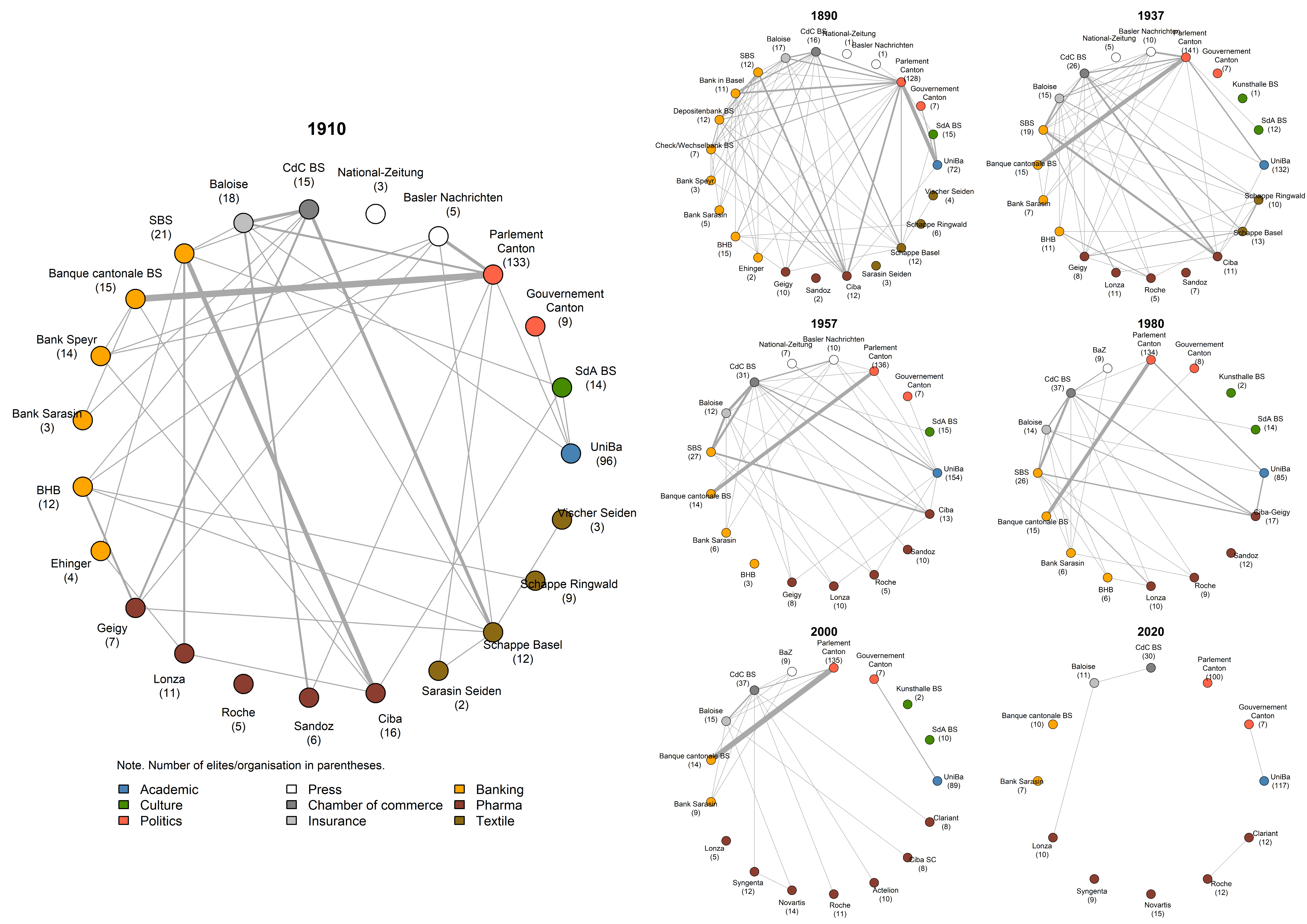
The evolution of urban power structures in Basel, 1890-2020; circles indicate organizations, grey lines indicate individuals that hold a position of power in two organizations at the same time (the thicker the line, the more individuals simultaneoulsy hold positions in two organizations); source: own graph based on data from the Swiss Elite Observatory.
Who are the elites who control the key institutions in Swiss cities? Studying these urban elites and the evolution of urban power structures together with historians and sociologists is my third research focus. In the framework of the SNSF-Sinergia project “Local power structures and transnational connections” we have built a database of over 9,500 individuals that hold positions of power in large companies, regional chambers of commerce, local and cantonal parliaments and governments, local art societies, as well as universities in the cities of Basel, Geneva, and Zurich between 1890 and 2020. Using network, prosopographical, and spatial analysis techniques, we uncover an evolution from a highly integrated and homogeneous power elite at the beginning of the 20th century – characterized by strong kinship and positional network ties, as well as geographical concentration in elite neighborhoods – to a more fragmented and diverse urban elite – both geographically and socially differentiated – at the beginning of the 21st century.
Published works:
- “Getting rid of their ties. The long-term evolution of elite networks and profiles in the three largest Swiss cities, 1890-2020,” Archiv für Sozialgeschichte, with Baptiste Antoniazza and André Mach.
- “From local champions to global players: A long-term perspective on Swiss companies’ connections across territorial scales,” Global Networks, with André Mach.
- “The urban left in power: Comparing the profiles of ‘municipal socialists’ and the ‘new urban left’ in Swiss cities,” International Journal of Urban and Regional Research, with Baptiste Antoniazza and André Mach.
- “The Swiss patrician families between decline and persistence: Power positions and kinship ties (1890-1957),” Social Science History, with Pierre Benz, Pedro Araujo, Geoffroy Legentilhomme, André Mach, Steven Piguet, and Emilie Widmer.
- Élites et pouvoir dans les grandes villes suisses, 1890-2020 [Elites and power in large Swiss cities, 1890-2020], Neuchâtel: Livreo-Alphil, co-edited volume with André Mach, Pedro Araujo, Pierre Benz, Claire-Lise Debluë, and Geoffroy Legentilhomme.
- “The residential patterns of Swiss urban elites. Continuity and change across elite categories (1890-2000),” European Societies, with Pierre Benz, Roberto di Capua, and André Mach.
- “The front and the back stage of power: Formal and informal social capital among business elites in the three largest Swiss cities, 1890–2000,” Sociology, with Pierre Benz, Pedro Araujo, and Thierry Rossier.
Work in progress:
- “The rise of the left in Swiss cities, 1980–2020,” with Sean Mueller [Presented at SVPW Annual Conference 2022, and at the ECPR Joint Sessions 2023] [.pdf]
 Michael A. Strebel